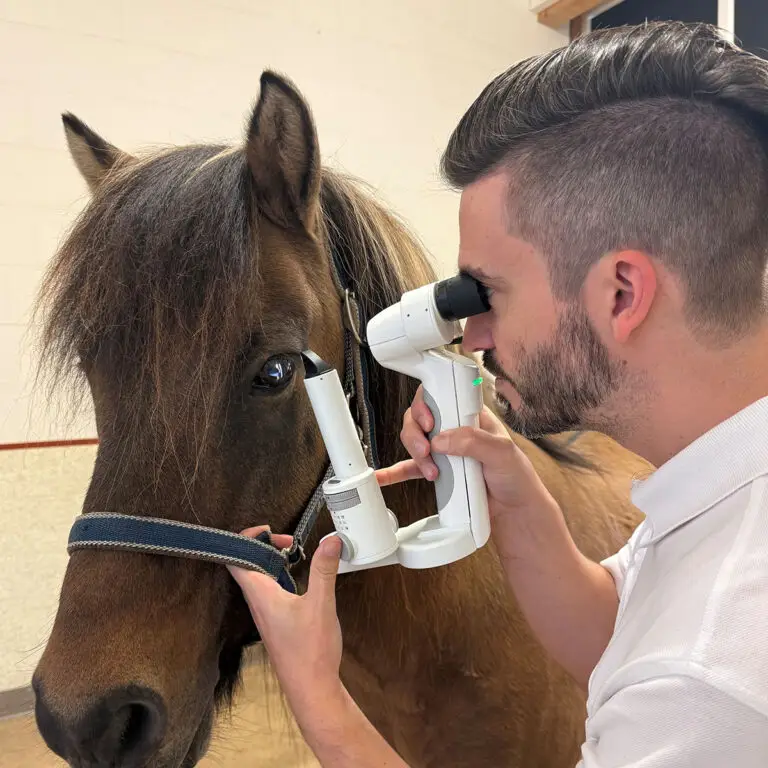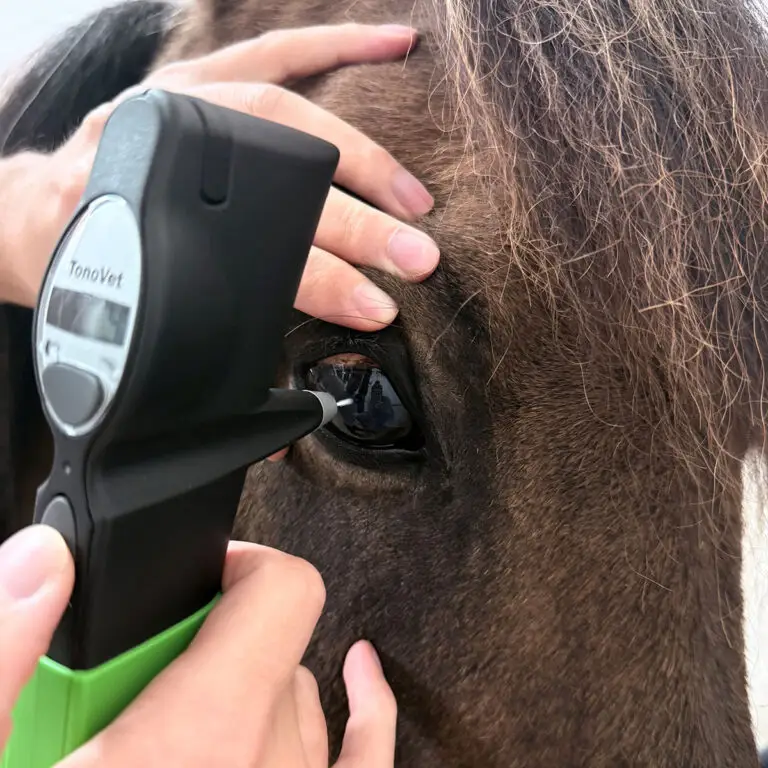

In collaboration with Dr. Blohm, we provide the full spectrum of diagnostic and surgical services based on the latest knowledge in equine ophthalmology.
The comprehensive ophthalmic examination includes distance vision, neuro-ophthalmic assessment, and direct and indirect ophthalmoscopy, as well as slit-lamp examination of both the anterior and posterior segments of the eye. Intraocular pressure measurement is an essential component of the complete eye examination. If visualization of the posterior segment is hindered by pupil constriction or corneal or lens opacities, ultrasound remains a valuable tool for assessing this region. An electroretinography (ERG) can also be performed to evaluate retinal function. Depending on the clinical findings and indications, samples may be collected and analysed.
If a foreign body is suspected or there is an injury or growth in the bony eye socket (orbit), X-ray and/or computed tomography (CT) imaging can be performed in addition to the ultrasound examination.
Depending on the severity of the disease, our range of services also includes conservative intensive care for ophthalmic patients as well as surgical treatment of eye diseases. This includes the management of eyelid and corneal injuries. Surgical treatment of complicated/infected corneal ulcers may involve removal of diseased corneal tissue and various grafts (e.g., conjunctival flap plasty) in cases of deep ulceration. Equine recurrent uveitis is treated surgically, with vitreous injection and concurrent aqueous humor sampling. Tumor removal of the eye and periocular region is also possible, as are various laser therapies (in addition to tumor removal, photodynamic therapy for immune-mediated keratitis, laser treatment for iris tumors or cysts). Increased intraocular pressure (glaucoma) can be controlled with laser therapy (cyclophotocoagulation) and/or shunt surgery. Lens opacities that significantly impair the horse’s vision (cataracts) can be removed by phacoemulsification with aspiration of the opacified lens material under a surgical microscope; if feasible, an artificial intraocular lens should be implanted.
In very painful and uncooperative patients, and after delicate procedures with frequent postoperative care, medication can be administered via a catheter inserted through the eyelid. Nowadays, many surgeries can be performed on cooperative horses in a standing position under local anesthesia without general anesthesia—this is gentler and less risky for your horse.
Appointments with our consulting eye specialist, Dr. Blohm, can be arranged on Mondays. However, the Pferdeklinik Bargteheide team is available for eye patients at any time and can consult Dr. Blohm as needed, depending on the issue.
Dr. Klaas-Ole Blohm
Dr. Klaas-Ole Blohm studied veterinary medicine at the Free University of Berlin. He subsequently worked in the Equine Clinic (2014–2015) and on the Ophthalmology ward (2016–2020) at the University of Veterinary Medicine Vienna. Dr. Blohm has been a member of the International Equine Ophthalmology Consortium since 2017. In 2020, he completed his PhD in a pilot project on contrast-enhanced ultrasound of the eye in dogs and horses.
Dr. Blohm successfully completed the three-year European veterinary ophthalmology training in 2021 with the Diplomate examination of the European College of Veterinary Ophthalmologists. He trains residents of this college in Germany and Spain in equine ophthalmology and is a regular speaker at national and international conferences.
Dr. Blohm has been working as a freelance consultant at Pferdeklinik Bargteheide since 2025.