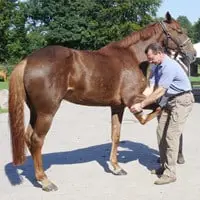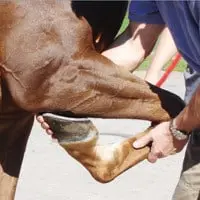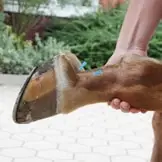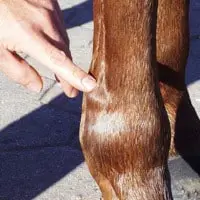

Orthopedics is one of the focal areas of veterinary practice in our clinic. It encompasses the diagnosis and treatment of musculoskeletal disorders such as lameness, back pain, riding problems, and limb deformities. A thorough clinical assessment of the patient is always the first step in the examination process. In addition, we have access to an objective gait analysis using artificial intelligence (AI). This motion analysis can be used to better illustrate subtle lameness and also to document progress in rehabilitation. The horse's movement is filmed using the Sleip app, and the asymmetries of the movement are calculated with an accuracy of 2mm. For diagnostic purposes, we utilize various modern imaging techniques such as digital radiography, ultrasound, scintigraphy, magnetic resonance imaging (MRI), and computed tomography (CT).
Therapeutically, the clinic offers a wide range of modern, proven treatment concepts. These include, among others, joint injections, ultrasound-guided tendon and joint injections, shockwave therapy, cryotherapy, and regenerative medicine treatments (IRAP, PRP, PRF, ACP, stem cells). Additionally, in collaboration with the farrier Max Kase, we offer custom orthopedic hoof shoeing tailored to the individual patient during their stay at the clinic.
The orthopaedic Surgery is another focus of our clinical activities. In addition to Arthroscopy and tendovaginoscopy the surgical treatment of fractures (osteosynthesis), misalignments and injuries.
Back Pain and Riding Problems
Many riding issues are caused by problems along the horse’s spine. An examination for such issues often requires the patient to be ridden (either by the owner or a test rider). A thorough clinical examination provides the veterinarian with crucial information and helps determine the next steps. In most cases, radiographic imaging of the spine is necessary. Additionally, scintigraphy often provides valuable diagnostic insights for conditions that are not visible or assessable on radiographs, particularly in the cervical and thoracolumbar regions.
Based on the results of these examinations, targeted treatments such as local injections (sometimes ultrasound-guided) or shockwave therapy may be administered. Chiropractic care is also frequently used for both diagnostics and therapy. Often, alongside veterinary treatment, a specific movement program involving targeted gymnastics is required for successful treatment. In such cases, our veterinarians will create an individually tailored and well-coordinated training program for you and your horse.
Limb Deformities
Acquired and congenital limb deformities (e.g., overreach, toe-out, tendon bowing, X- and O-leggedness, wind-swept, etc.) are particularly significant in foals. In the foal stage, there is still the potential for lasting influence on such positional anomalies.
Radiographic images are used to assess the healing prognosis and monitor the healing process. Treatment depends on the type and severity of the deformity. A variety of orthopedic measures, such as hoof boots, splints, support bandages, shockwave therapy, and pharmaceutical treatments, are available.
In more severe cases, surgery is unavoidable. Commonly used and established surgical techniques include periosteal lifting, sectioning of supporting ligaments, and the use of screws for unilateral growth inhibition.